
#AtoZ - Business Intelligence, reporting and analytics at the service of modern businesses
Why understanding your data matters more than collecting it
Data is everywhere, but insight is rare. Business Intelligence bridges that gap, giving organisations the tools to move from information overload to confident, informed action.
From data overload to business clarity
What separates companies that grow from those that stagnate? Increasingly, the answer lies not in how much data they collect, but in how well they understand it. This is exactly what Business Intelligence (BI) addresses: a set of tools, processes and technologies that turn raw enterprise data into clear, up-to-date and actionable information.
More than just a technology, BI has become a true driver of performance, efficiency and competitiveness.
Today, a new generation of BI is emerging, enriched with artificial intelligence integrated directly into BI solutions such as Sage Enterprise Intelligence. These tools do not simply analyse data, they actively guide users in their decision-making, in real time and without requiring any technical expertise.
What is Business Intelligence?
Business Intelligence refers to a set of technologies and processes that enable organisations to collect, integrate, analyse and visualise enterprise data in order to support better decision-making.
BI relies primarily on:
- collecting and integrating data from multiple sources (ERP, CRM, spreadsheets…),
- data warehouses and OLAP technology for fast processing of large volumes of data,
- reporting and dashboards for performance visualisation,
- advanced analytics for identifying trends and variances.
Within organisations, these technologies make it possible to eliminate manual reporting work, gain real-time visibility and improve the quality of both strategic and operational decisions.
How BI has evolved - from reporting to intelligent analytics
The use of BI in organisations has progressed through several stages:
- Descriptive BI: understand what happened (classic reporting)
- Diagnostic BI: understand why it happened (root cause analysis)
- Predictive BI: anticipate what could happen (trend modelling)
- Prescriptive BI: recommend actions to take
- AI-assisted BI: interactive data exploration in natural language, with AI that explains context and suggests next steps
This evolution illustrates a deep transformation of information systems: today it is no longer enough simply to inform. Modern BI tools actively participate in decision-making.
Why is BI critical for businesses?
When data starts speaking for itself
Most ERP systems lack a standardised way to access enterprise-wide information. Teams rely on tools that require heavy manual effort, making the process slow, fragmented and costly. The result is data silos, where departments have no efficient way to collaborate or quickly access the insights they need.
A modern BI solution addresses this problem: it centralises data, makes it accessible to all users and allows everyone to get answers without depending on the IT department.
Concretely, BI enables organisations to:
- monitor key performance indicators (KPIs) in real time,
- identify variances against budget or forecasts,
- detect trends in sales, production or inventory before they become a problem,
- consolidate data from multiple systems into a single, unified view.
The goal is not to replace human expertise, but to strengthen it:
- detect weak signals earlier,
- gain a more nuanced and dynamic reading of data,
- prioritise actions according to their potential impact,
- move from reactive management to a truly proactive approach.
BI enhanced by Artificial Intelligence
The real evolution today lies not only in what is analysed, but in how that analysis is acted upon.
Modern BI tools with AI integration make it possible to:
- ask questions in plain language without any technical knowledge,
- receive automatically generated recommendations and insights,
- detect anomalies and variances in real time,
- understand not just what is happening, but also why – and what to do next.
This evolution marks a significant shift: BI is no longer limited to providing information, it is becoming an active assistant embedded in everyday business processes.
Sage Enterprise Intelligence - BI directly within your Sage X3
Practical BI in an ERP environment
Sage Enterprise Intelligence (SEI) is an intuitive BI solution fully integrated with Sage X3. Its purpose is to reduce time spent on analysis and reporting, and to give all users, regardless of technical background, fast, self-sufficient access to enterprise data.
Key benefits of SEI:
- Visibility and insight: An enterprise-wide view of your organisation with real-time reporting across web, Excel and mobile devices.
- User empowerment: Self-service BI lets everyone create reports and dashboards without depending on IT.
- Secure collaboration: Share data with internal and external stakeholders, including scheduled report distribution and conditional alerts.
- Data management: Synchronisation, consolidation and migration of data from multiple sources into one reliable foundation.
- Fast ROI: Ready-to-use templates, quick implementation and optimised performance thanks to OLAP technology.
SEI features include:
- intuitive user interface with multi-browser support,
- real-time data, fully integrated with Sage X3,
- fast processing of large volumes of data,
- ready-to-use KPIs and templates,
- extensive data visualisation (charts, maps, gauges),
- Microsoft® Excel® Add-In,
- mobile access from anywhere.
SEI is compatible with Sage X3, Sage 100, Sage 200, Sage 300, Sage 500, Sage CRM and Sage XRT.
Artificial Intelligence in Sage Enterprise Intelligence
Sage Enterprise Intelligence goes a step further today, its integrated AI takes analytics to a whole new level. It transforms complex data into clear, actionable insights in real time. It does not just answer the question what happened, it helps you understand why it happened and highlights what to explore next.
Examples of questions you can ask directly in SEI:
- „Show me sales by region for this quarter.”
- „What explains the drop in net margin this month?”
- „Help me identify the most important points on my dashboard for the board meeting.”
- „Recommend ways to make this visualisation clearer and more compelling.”
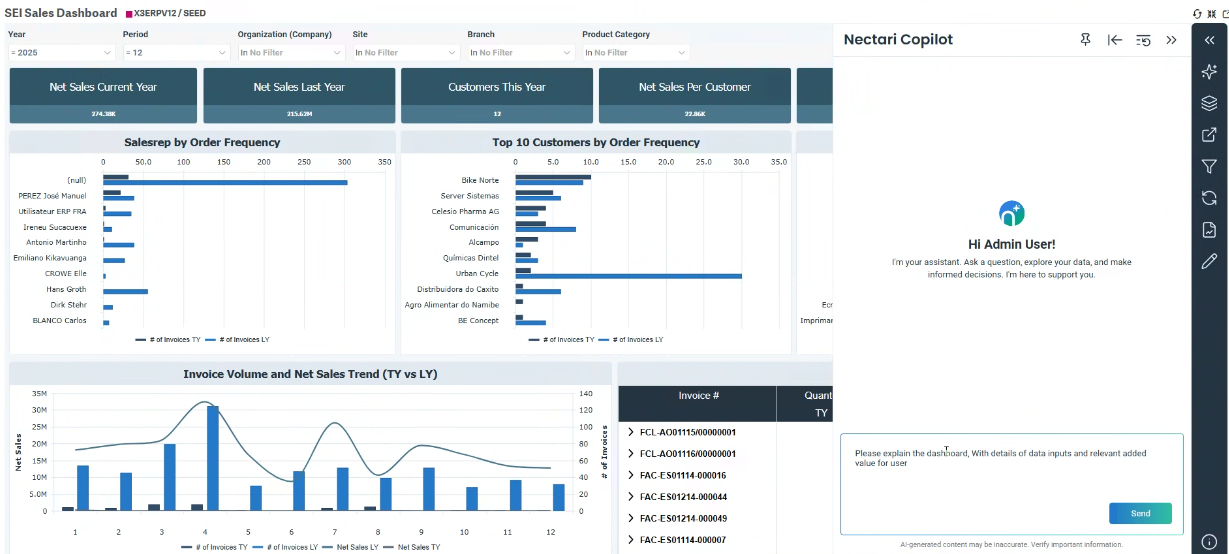
The AI assistant is available directly within Sage Enterprise Intelligence and enables:
- interactive data exploration without technical knowledge,
- automatic generation of insights and recommendations,
- instant detection of trends and anomalies,
- a seamless transition from insight to action.
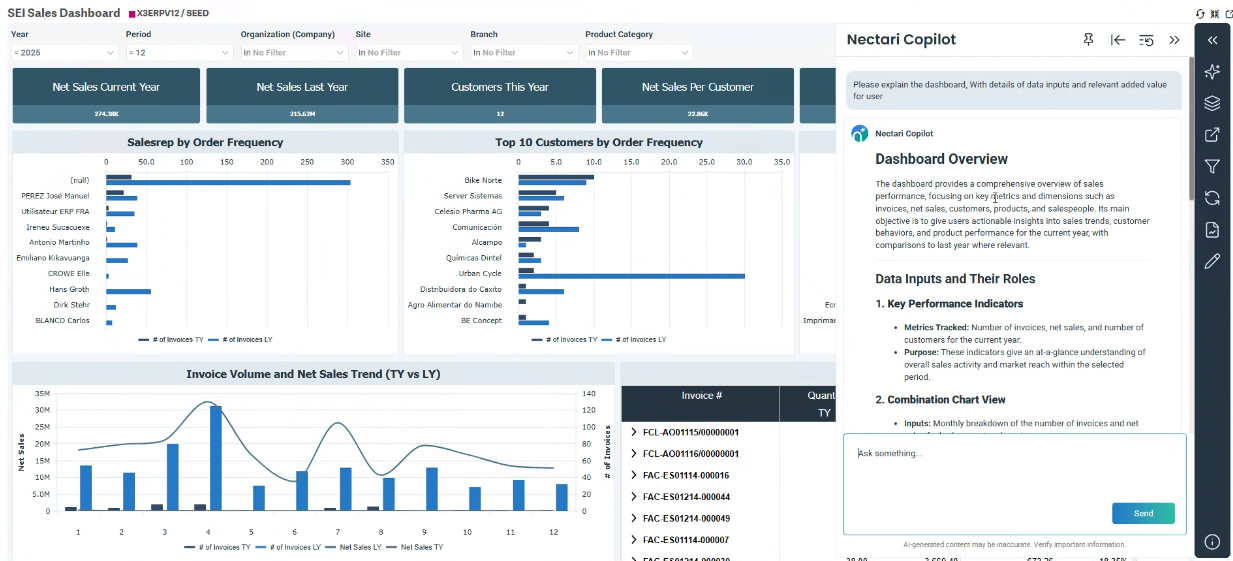
At the heart of this AI experience is SEI Copilot, an intelligent assistant embedded directly within the platform. SEI Copilot takes analytics to a whole new level by turning complex data into clear, actionable insights in real time. It goes beyond simply reporting what happened. It helps users understand why it happened, highlights what to explore next, and provides AI-powered guidance on where to focus, how to present insights, and which opportunities to pursue. Users can ask questions in plain language, uncover trends instantly, and move effortlessly from insight to action, spending less time searching and more time delivering impactful results.
Implementing BI - A technological and organisational challenge
Deploying Business Intelligence is not simply a matter of activating a feature. It is above all a transformation project that touches both tools and organisational practices.
It requires:
- Data quality: without reliable, complete and consistent data, no tool can produce usable results,
- Clear governance: definition of responsibilities, usage rules and validation processes,
- Business team buy-in: recommendations must be understood, contextualised and integrated into everyday decisions,
- Ethical and operational vigilance: model transparency, traceability of results and regulatory compliance.
Without this alignment, there is a risk that BI remains a sophisticated tool… that is rarely put to good use.
In summary
Business Intelligence is gradually transforming the way companies work with their data and make decisions.
It first enabled a better understanding of the past through reporting and descriptive analysis. It then made it possible to anticipate the future through predictive analytics. Today, a new chapter is opening with AI assistants that guide users in their day-to-day decision-making, in plain language and without technical barriers.
The value of BI lies not only in the technology itself, but in the ability of organisations to embed it in their processes, combining reliable data, human expertise and appropriate governance.
Companies that succeed in this transformation will gain a lasting competitive advantage in an environment where the speed and quality of decisions are increasingly decisive.
Want to learn more about Sage Enterprise Intelligence and BI opportunities for your business? Contact us