< Blog
#AtoZ - Artificial Intelligence - From Data to Action: AI at the Heart of Corporate Performance
Artificial intelligence (AI) is currently at the very core of corporate digital transformations. But in practical terms, what does it actually change for management systems?
Long limited to data centralisation and operational management, ERP systems are progressively evolving into genuine decision-making assistants. Today, they no longer simply record information: they analyse workflows in real time, detect anomalies, anticipate trends, and actively support users in their day-to-day activities.
In this context, management systems are becoming smarter. They are now capable of understanding the business context, formulating relevant recommendations, and, increasingly, preparing specific operational actions under human supervision.
Driven by predictive analytics and the rise of intelligent agents, this new generation of AI marks a major milestone in the evolution of ERP and financial tools.
This transformation is no longer just theoretical.
Indeed, according to McKinsey, generative AI could add between $2,600 to $4,400 billion of incremental economic value annually on a global scale.
Furthermore, initial field feedback already confirms tangible gains. A study conducted among more than 5,000 customer service agents demonstrated an average 14% increase in the number of cases resolved per hour, thanks to AI assistance.
These results illustrate a clear trend: AI does not just automate; it directly enhances productivity and the quality of decision-making.
Artificial intelligence encompasses a suite of technologies capable of simulating certain human capabilities, such as learning, analysis, reasoning, and decision-making.
In practice, it primarily relies on:
Within enterprises, these technologies make it possible to automate repetitive tasks, extract insights from massive volumes of data, and significantly improve the quality of decisions.
Disclaimer: This article is based on original content published by Sage, entitled “Predictive analytics and AI to boost your cash flow” (read here), which we have supplemented with concrete examples and specific perspectives tailored to our solutions, Sage X3 and Sage Intacct.
Before going any further, it is essential to distinguish between the main types of artificial intelligence used in business today.
| Type of AI | Objective | Example |
| Generative AI | Produce content or answer queries | Generating a report, summarising a meeting |
| Predictive AI | Anticipate future events | Forecasting cash flow, detecting a late payment |
| Agentic AI | Execute or prepare business actions | Launching a customer chase-up, triggering a workflow |
These approaches are entirely complementary. Generative AI facilitates the production and understanding of information. Predictive AI enables businesses to anticipate. Meanwhile, Agentic AI acts directly within business processes, under human oversight.
The use of artificial intelligence within organisations has evolved progressively.
First, descriptive AI made it possible to understand what happened. Next, diagnostic AI helped explain the causes. Then, predictive AI paved the way for anticipating future events.
Subsequently, prescriptive AI introduced action recommendations. Finally, agentic AI represents the latest milestone, capable of preparing or executing specific business tasks under human supervision.
This progression illustrates a profound transformation of information systems, which no longer merely inform, but now actively participate in decision and action.
Among the most structural applications of AI in business, predictive analytics occupies a central position.
It relies on exploiting historical and real-time data to identify trends, correlations, and probable scenarios. Thanks to machine learning, it models future behaviours based on past data.
Unlike traditional reporting, which merely describes the past, predictive analytics aims to project what might happen next.
In a more advanced setup, it combines internal data (cash flow, sales, customer behaviour) with external data (market trends, competition, industry shifts).
Consequently, it offers a more comprehensive and dynamic view of potential developments.
In practical terms, it specifically enables businesses to:
In this context, the objective is not to replace human expertise, but to reinforce it.
Predictive analytics makes it possible to detect weak signals earlier, refine data interpretation, and prioritise actions based on their potential impact.
Progressively, companies are moving away from a reactive mindset and embracing a genuinely proactive approach.
This evolution is already yielding tangible results. According to PwC, sectors most advanced in AI adoption record a 4.3% productivity growth, compared to 0.9% in less exposed sectors.
As a result, predictive analytics is becoming a direct lever for optimising performance and competitiveness.
Current developments are no longer just about prediction, but also about action.
Intelligent agents now make it possible to:
However, these actions remain strictly governed by compliance rules and require human validation in sensitive contexts. Thus, AI becomes a true operational assistant embedded within business processes.
In financial and decision-making environments, these technologies are already actively deployed.
AI assistants integrated into management solutions allow direct interaction with data using natural language.
They notably offer:
Users can therefore query their systems directly, for instance, to analyse a drop in turnover, understand cash flow evolution, or identify outstanding invoices impacting liquidity.
Since 2025, Sage has embedded Sage Copilot into Sage X3, marking a major shift towards an “AI-augmented” ERP. In 2026, the solution has crossed a new threshold: it is no longer confined to an isolated conversational interface, but has become a genuine operational intelligence engine integrated into the Sage X3 environment and business practices.
Sage Copilot has been available since the Sage X3 Release 2025 R2 (12.0.38). This version serves as the launchpad for its progressive integration into the ERP ecosystem, featuring a rapid ramp-up of use cases tied to data analysis, user assistance, and navigation across X3 objects.
Concrètely, Sage Copilot is accessible as a conversational interface fully embedded within Sage X3. Users can open it from their workspace without interrupting their current ERP screens (sales, accounts, purchasing, stock).
Interaction happens in natural language, directly connected to live system data. Users no longer need to navigate menus manually, filter lists, or build technical queries. The goal is not just to “answer questions”, but to enable guided data exploration within the business context.
Sage Copilot does more than just display textual answers; it acts as a business assistant tied directly to X3 objects.
Practical examples of use:

Thanks to Natural Language Processing (NLP) technologies, Sage Copilot allows direct interaction with Sage X3 data:
Intuitive data exploration : Users no longer need to master complex filters or build technical queries. The AI queries data from Sage X3 (finance, sales, supply chain, production) and delivers structured, understandable, and directly actionable responses.
Identification of data variances or anomalies : Beyond simple querying, the system continuously monitors operational workflows. It is capable of identifying significant budgetary, financial, or operational variances, and flagging them before they impact company performance.
Automatic generation of insights : Sage Copilot also produces insight cards, highlighting trends or weak signals:
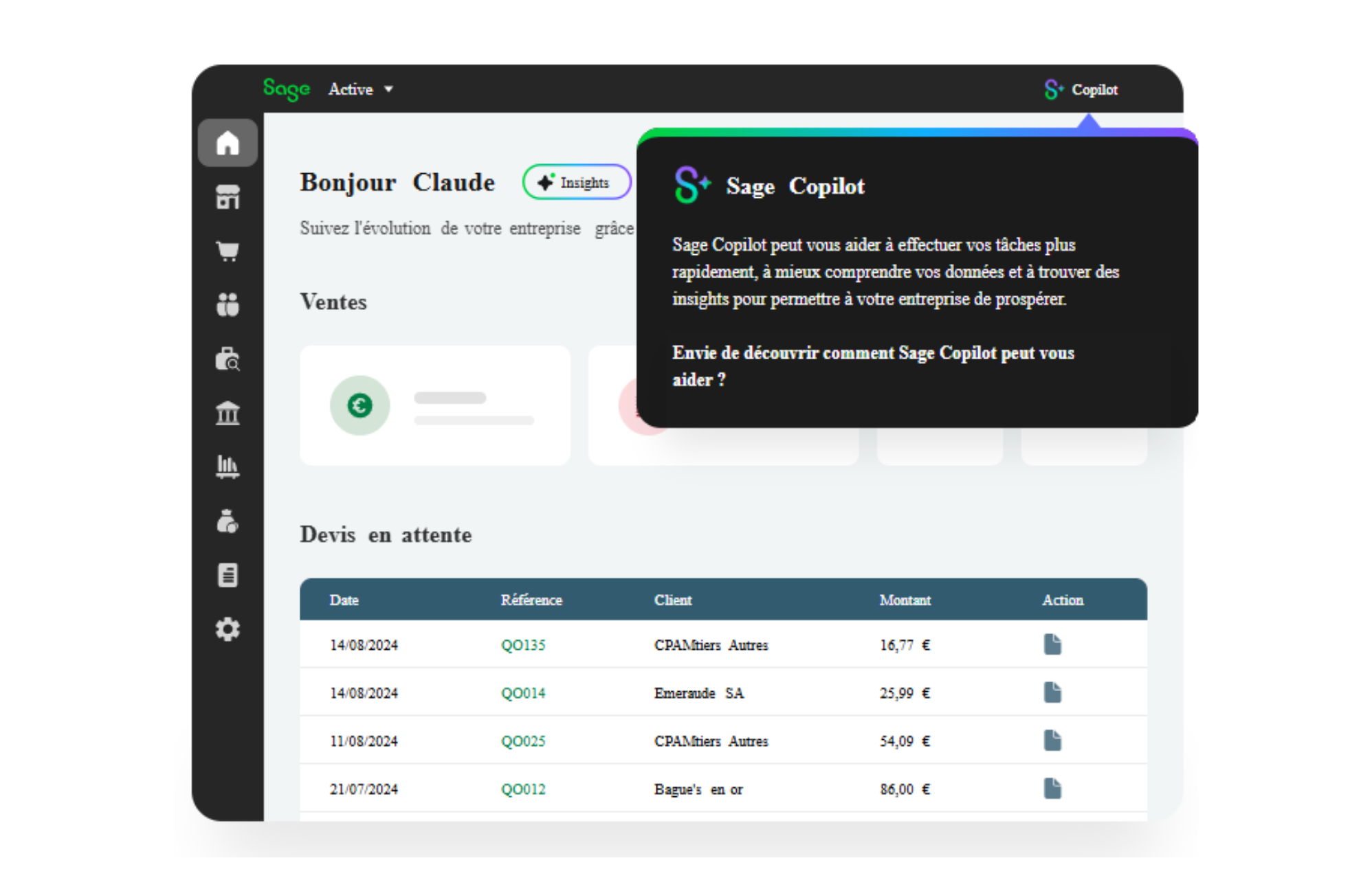
These features are gradually transforming Sage X3 into a more interactive and intelligent analytical environment, one that is no longer focused solely on generating data, but on its immediate and operational interpretation.
In modern financial environments, Artificial Intelligence does more than just produce analyses: it has become a genuine lever for automation and continuous steering. Sage Intacct perfectly illustrates this shift with an approach centered on augmented finance, where teams gain speed, reliability, and foresight.
One of the most significant evolutions in Sage Intacct is the transition towards a continuous close. The objective is no longer to wait for the month-end to analyse results, but to have financial records updated in real time.
Thanks to AI and automation:
This approach profoundly reshapes the role of finance teams: they shift from a posteriori control to continuous piloting, seamlessly embedded into the company’s operations.
According to Deloitte, automating closing processes significantly reduces the workload for finance teams while improving the speed and reliability of financial reporting. The most advanced organisations no longer talk about a monthly close, but rather a continuous accounting process integrated into operational management.
The AI embedded within Sage Intacct goes beyond executing rigid accounting rules. It learns from historical patterns to:
The benefit is not merely fixing errors faster, but preventing financial slippage before it impacts the bottom line.
The latest developments extend far beyond traditional automation:
AI acts here as an operational assistant for the finance function, drastically reducing repetitive tasks whilst increasing data reliability.
With Nectari AI Copilot, you instantly transform complex data into clear, actionable information within Sage Enterprise Intelligence. The arrival of Nectari AI Copilot marks a major step towards conversational and augmented BI.
Thanks to generative AI, users can now interact directly with their data:
The tool does not just provide an answer: it explains, contextualises, and highlights key drivers.
Nectari AI Copilot introduces automated data storytelling:
This reduces dependence on manual analysis and accelerates decision-making.
The next step involves transforming BI into a proactive system:
BI no longer simply answers questions: it suggests the right questions to ask.
In the field of invoice scanning and accounts payable (AP) automation, Yooz stands out as a benchmark solution for document AI and automated accounting.
Yooz’s AI relies on deep learning technologies capable of:
Unlike traditional approaches based on rigid OCR rules, Yooz leverages contextual document understanding.
Recent developments are moving towards a virtually autonomous Purchase-to-Pay process:
The medium-term objective is clear: driving towards a “zero manual processing” model, where human intervention is reserved solely for controlling and validating exceptional cases.
Want to find out more? Contact us
Implementing predictive analytics or AI systems is not limited to deploying an extra feature or software tool. It is, above all, a profound transformation that impacts technologies, processes, and working practices alike.
This transformation rests on several essential pillars:
Flawless data quality: Reliable, complete, and consistent data is indispensable to guarantee model relevance. Without it, outputs lose value and reliability.
Clear governance: It is necessary to define responsibilities, usage rules, and validation processes to wrap a framework around AI usage.
Genuine business adoption: Results and recommendations must be understood, interpreted, and integrated into daily decision-making to create real value.
Ethical and operational vigilance: Model transparency, decision traceability, bias management, and compliance with regulatory requirements must be integrated right from the design stage.
Without this alignment between technology, data, and organisation, AI risks remaining a powerful tool on paper, but limited in its actual business impact.
AI is progressively and profoundly transforming corporate management systems and decision-making models.
Initially, it enabled a better understanding of the past through reporting and descriptive analytics. It then paved the way for anticipating future events via predictive analytics. Today, a new chapter is unfolding with the emergence of intelligent agents, capable not only of analysing and recommending, but also of concretely assisting users in executing specific business tasks.
The true value of AI therefore does not reside solely in the technology itself, but in its capacity to integrate effectively into organisations. This requires a balanced combination of reliable data, human expertise, and a robust governance framework.
Early feedback proves that the benefits of AI are real but heavily dependent on implementation quality. According to McKinsey, top-performing companies in AI adoption are starting to observe a return on investment of up to three pounds generated for every pound invested.
Businesses that successfully navigate this transformation will secure a sustainable competitive advantage in an environment where the speed, quality, and relevance of decisions have become critical performance factors.